|
|
Course Description:
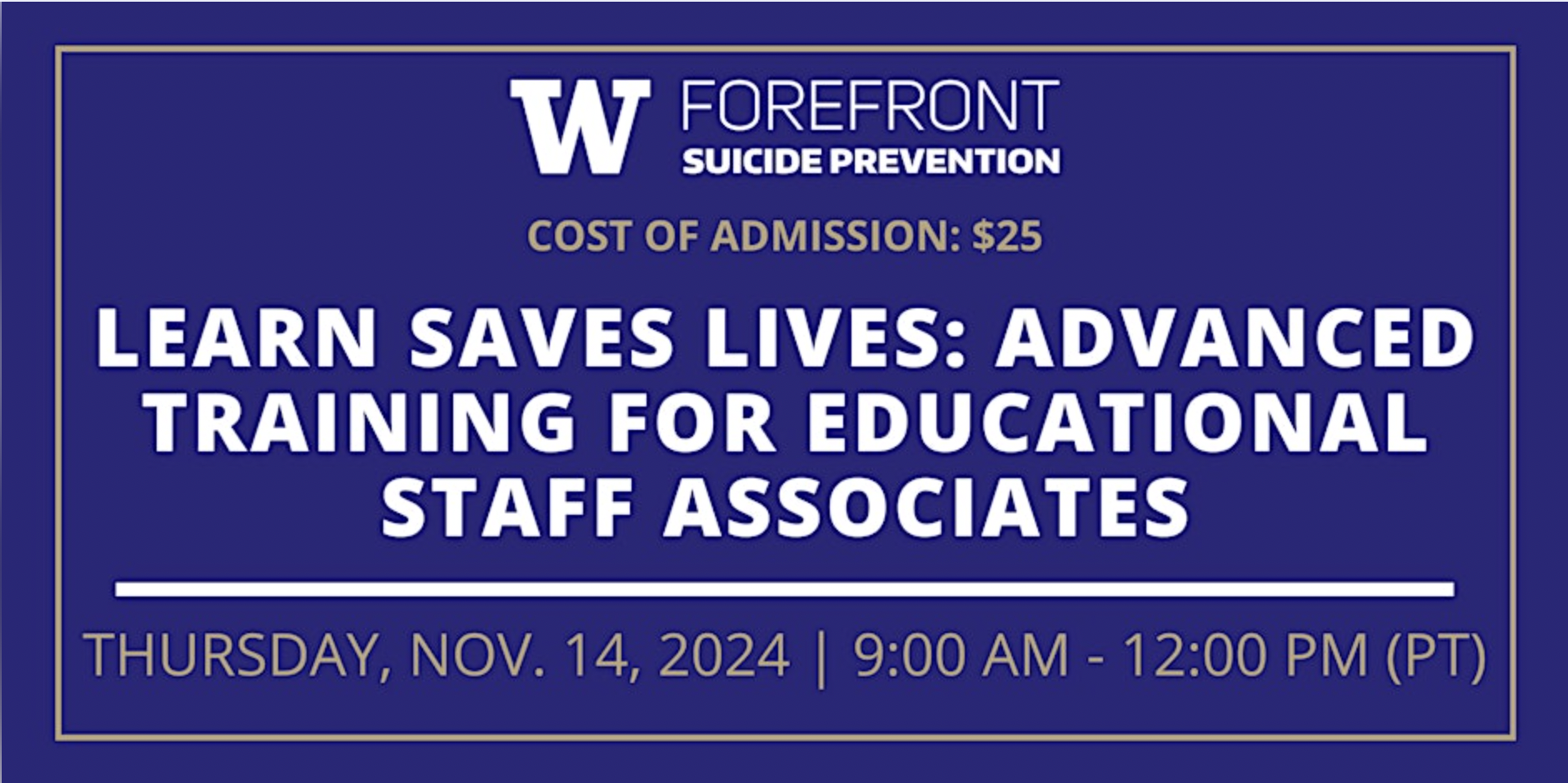
Many of us have confided in others during dark times, and vice versa. But it can feel awkward, if not downright frightening, not knowing what to do when a loved one or a peer shows suicide warning signs. Developed by Forefront, the five simple and effective LEARN steps empower individuals to help others move in the direction of hope, recovery, and survival. The Advanced LEARN for Educational Staff Associates covers additional important topics for school staff, including suicide screening and safety planning intervention, and gives participants an opportunity to practice these important skills with experts in the field. The Advanced LEARN is listed as a model course by the WA Department of Health.
Detailed Agenda:
00:30: Introduction and public health issue of youth suicide (Covers risk factors, why people die by suicide, and recent data)
00:30 – 2:00: Suicide prevention skills using Forefront’s LEARN model (Includes imminent harm by lethal means, practice using screening tools, and key components of safety planning intervention)
2:00 – 3:00: Prevention approaches practice (Gives participants an opportunity to practice completing a safety planning intervention with their peers)
Learning Objectives:
Overview:
– Explain the public health issue of youth suicide & why people die by suicide- Understand Forefront’s LEARN model
Screening:
– Identify an individual at risk for suicide & use the ASQ screening tool
Safety Planning:
– Complete a safety plan for an individual at risk for suicide
Please note: This course is listed as a model course by the WA Department of Health and meets the 3 Hour training requirement for ESA staff, ESAs needing to document their suicide prevention hours can use form 4020-S. Educators are eligible for up to three (3) clock hours for completing the suicide prevention training course.
This workshop has been approved for 3 CEUs by the Washington Chapter, National Association of Social Workers (NASW) for Licensed Social Workers, Licensed Marriage & Family Therapists and Licensed Mental Health Counselors. Our Provider number is #1975-473. NASW is also an approved clock hour provider for Educators.

Wednesday, October 30, 2024, 8:30 AM - 2:30 PM, A Live Webinar, , CA
Please note the course begins at 8:30 AM (PDT) / 11:30 AM (EDT).
With suicide rates increasing by 30% in the last 2 decades, suicide remains a pressing public health challenge. This course provides an overview of key topics in suicide assessment, prevention, and treatment that is relevant to all treatment settings and clinical disciplines. This course will cover assessment factors such as family history, past trauma, social isolation, and support systems and cultural/religious beliefs that stigmatize mental health or suicide. Prevention topics addressed will cover recognizing warning signs, responding to crises, and understanding biological and psychological models that are relevant to clinical practice. Putting concepts into practice, the course will also cover treatment methods such as psychotherapy, medication, hospitalization for acute risk or severe mental health crises, collaborative care models, follow-up care and ongoing monitoring.
Click here for overview and registration
Live/On-Demand Learners (No Awarded): Free
CME/CE Credit Seeking Learners: $60
The Zoom link for the webinar will be sent to you via email during the week leading up to the event. Be sure to use an email address you check frequently.
For those who register, they will receive a link to the 247 page comprehensive and recently updated online resource entitled Current Status of Suicide-Focused Assessment and Treatment - click here to see an overview.
After this live event occurs, the course content will be made available for on-demand access and CE credit. Please check back in the weeks following the live event for more details/access to the on-demand content. You may also sign up for the Stanford CME newsletter here for updates on this and all other upcoming CME events.
Note: Creation of a CloudCME account is required to register for the course. If you are creating an account for the first time, you will need to create your CloudCME account, and then revisit the course registration page to officially register for the course*
AMA PRA Category 1 Credits™ (5.25 hours), ANCC Contact Hours (5.25 hours), APA Continuing Education credits (5.25 hours), ASWB Continuing Education (ACE) credits (5.25 hours), Non-Physician Participation Credit (5.25 hours)
In support of improving patient care, Stanford Medicine is jointly accredited by the Accreditation Council for Continuing Medical Education (ACCME), the Accreditation Council for Pharmacy Education (ACPE), and the American Nurses Credentialing Center (ANCC), to provide continuing education for the healthcare team.
Credit Designation
American Medical Association (AMA)
Stanford Medicine designates this Live Activity for a maximum of 5.25 AMA PRA Category 1 CreditsTM. Physicians should claim only the credit commensurate with the extent of their participation in the activity.
American Nurses Credentialing Center (ANCC)
Stanford Medicine designates this Live Activity for a maximum of 5.25 ANCC contact hours.
ASWB Approved Continuing Education Credit (ACE) – Social Work Credit
As a Jointly Accredited Organization, Stanford Medicine is approved to offer social work continuing education by the Association of Social Work Boards (ASWB) Approved Continuing Education (ACE) program. Organizations, not individual courses, are approved under this program. Regulatory boards are the final authority on courses accepted for continuing education credit. Social workers completing this activity receive 5.25 general continuing education credits.
American Psychological Association (APA)
Continuing Education (CE) credits for psychologists are provided through the co-sponsorship of the American Psychological Association (APA) Office of Continuing Education in Psychology (CEP). The APA CEP Office maintains responsibility for the content of the programs.
Cancellation Policy
The cancellation policy only applies to credit learners. Cancellations received in writing no less than 20 days before the course will be refunded. No refunds will be made on cancellations received after that date. Any cancellations refunded will less a 20% administrative fee. Please send cancellation requests to stanfordcme@stanford.edu.
Stanford University School of Medicine reserves the right to cancel or postpone this program if necessary; in the event of cancellation, course fees will be fully refunded.
Accessibility Statement Stanford University School of Medicine is committed to ensuring that its programs, services, goods and facilities are accessible to individuals with disabilities as specified under Section 504 of the Rehabilitation Act of 1973 and the Americans with Disabilities Amendments Act of 2008. If you have needs that require accommodations, please contact the CME Conference Coordinator.
Cultural and Linguistic Competency
The planners and speakers of this CME activity have been encouraged to address cultural issues relevant to their topic area for the purpose of complying with California Assembly Bill 1195. Moreover, the Stanford University School of Medicine Multicultural Health Portal contains many useful cultural and linguistic competency tools including culture guides, language access information and pertinent state and federal laws. You are encouraged to visit the Multicultural Health Portal: https://laneguides.stanford.edu/multicultural-health
For activity related questions, please contact
Name: Amanda Harrison
Title: Education Event Specialist
Email: amanda.harrison@stanford.edu
For CME general questions, please contact
Email: stanfordcme@stanford.edu
From NWRESD:

|